

Skip a heartbeat: OpenSSL Heartbleed Vulnerability & Prediction of Exploitation by Mehak Bashir - HTML preview
Download the book in PDF, ePub, Kindle for a complete version.
CHAPTER 4
PROPOSED WORK
4.1 Algorithm for Predicting Severity/Threat Of Exploitation Using Naive Bayes Approach
- Convert the data set into a frequency table.
- Create Likelihood table by finding the probabilities, like probability of High threat of exploitation is (4/7) = 0.57 and probability of Low threat of exploitation is (3/7) = 0.43.
- Now, use Naive Bayesian equation to calculate the posterior probability for each class. The class with the highest posterior probability is the outcome of prediction.
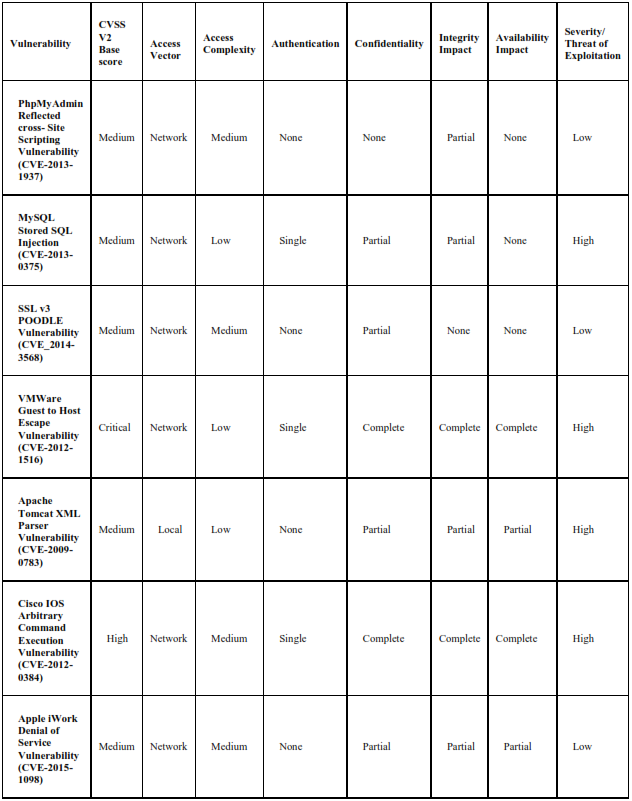
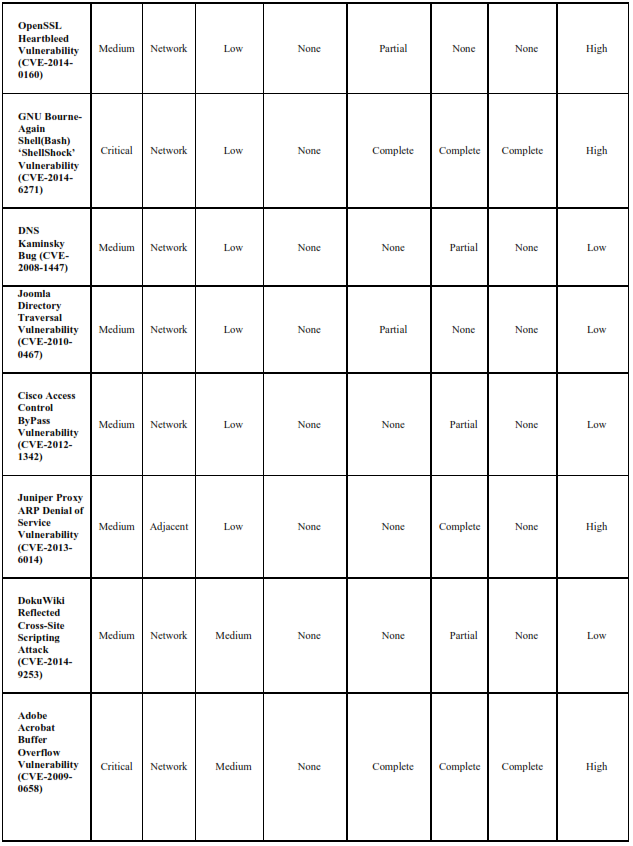
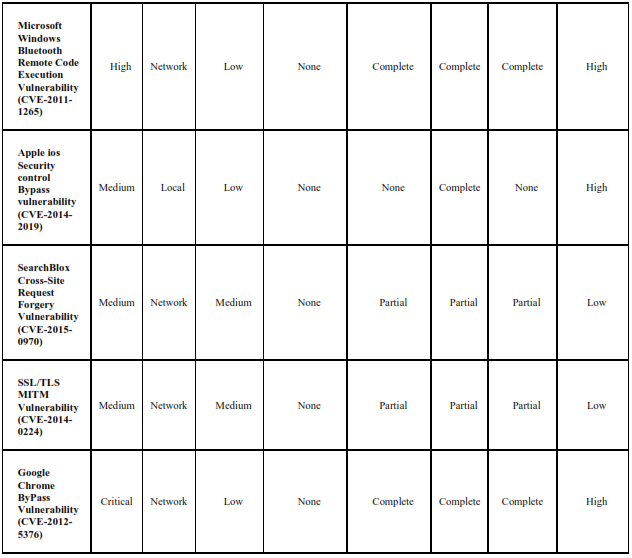
4.2 Frequency Table for Some Common Vulnerabilities Based on CVSS (Version2) Parameters
The values for CVSS (Version2) parameters: CVSS Score, Access Vector, Access, Complexity, Authentication, Confidentiality, Integrity and Availability for some common types of vulnerabilities such as PhpMyAdmin Reflected cross- Site Scripting Vulnerability (CVE-2013- 1937), MySQL Stored SQL Injection (CVE-2013-0375), SSL v3 POODLE Vulnerability (CVE_2014-3568), VMWare Guest to Host Escape Vulnerability (CVE-2012-1516), Apache Tomcat XML Parser Vulnerability (CVE-2009-0783), OpenSSL Heartbleed Vulnerability (CVE-2014-0160) etc. are tabulated in table 2.
TABLE 2: Frequency table for some common vulnerabilities using CVSS (version 2) Base Metrics
4.3 Likelihood Table for Finding the Probabilities(P) Of Various CVSS (version 2) Parameters
The likelihood table for finding the probabilities of various CVSS parameters : CVSS Score, Access Vector, Access, Complexity, Authentication, Confidentiality, Integrity and Availability, as defined in table 1, using the data presented in above frequency table (table 2) is depicted in table 3.
TABLE 3: Likelihood table for calculation of probabilities of CVSS (version 2) parameters
|
Severity/Threat of Exploitation |
|
|
P (High) = 12/21 = 4/7 |
P (Low) = 9/ 21 = 3/7 |
|
CVSS V2 Base score |
|
|
P (Low/ High) = 0/12 = 0 |
P(Low/ Low) = 0/9 = 0 |
|
P (Medium/ High) = 6/12 =1/2 |
P(Medium/ Low) = 9/9 = 1 |
|
P (High/ High) = 2/12 = 1/6 |
P(High/ Low) = 0/9 = 0 |
|
P (Critical/ High) = 4/12 = 1/3 |
P(Critical/ Low) = 0/9 = 0 |
|
Access Vector (AV) |
|
|
P (Local/ High) = 3/12 = 1/4 |
P (Local/ Low) = 0/9 = 0 |
|
P (Adjacent/ High)= 1/12 |
P (Adjacent/ Low) = 0/9 = 0 |
|
P (network/ High) = 8/12 = 2/3 |
P (Network/ Low) = 9/9 = 1 |
|
Access Complexity ( AC ) |
|
|
P (Low/ High) = 9/12 = 3/4 |
P (Low/ Low) = 3/9 = 1/3 |
|
P (Medium/ High)= 3/12 = 1/4 |
P (Medium/ Low) = 6/9 = 2/3 |
|
P (High/ High) = 0/12 = 0 |
P (High/ Low) = 0/9 = 0 |
|
Authentication (Au) |
|
|
P (None/ High) = 9/12 = 3/4 |
P (None/ Low) = 9/9 = 1 |
|
P (Single/ High)= 3/12 = 1/4 |
P (Single/ Low) = 0/9 = 0 |
|
P (Multiple/ High) = 0/12 = 0 |
P (Multiple/ Low) = 0/9 = 0 |
|
Confidentiality Impact (C) |
|
|
P (None/ High) = 2/12 = 1/6 |
P (None/ Low) = 4/9 |
|
P (Partial/ High)= 3/12 = 1/4 |
P (Partial/ Low) = 5/9 |
|
P (Complete/ High) = 7/12 |
P (Complete/ Low) = 0/9 = 0 |
|
Integrity Impact (I) |
|
|
P (None/ High) = 1/12 |
P (None/ Low) = 2/9 |
|
P (Partial/ High)= 2/12 = 1/6 |
P (Partial/ Low) = 7/9 |
|
P (Complete/ High) = 9/12 = 3/4 |
P (Complete/ Low) = 0/9 = 0 |
|
Availability Impact (A) |
|
|
P (None/ High) = 4/12 = 1/3 |
P (None/ Low) = 6/9 = 2/3 |
|
P (Partial/ High)= 1/12 |
P (Partial/ Low) = 3/9 = 1/3 |
|
P (Complete/ High) = 7/12 |
P (Complete/ Low) = 0/9 = 0 |
4.4 Using Naive Bayes Equation to Calculate the Posterior Probability for a Sample Class of Vulnerability, to Predict its Severity of Exploitation
Let A be a sample vulnerability with CVSS parameters as:
<Medium, Local, Low, None, Partial, Partial, Partial>
The posterior probability of sample class A, for given set of CVSS parameters, is calculated from table 3 as:
P (A/High) × P (High)
= P (Medium/High) × P (Local/High) × P (Low/High) × P (None/High) ×
P (Partial/High) × P (Partial/High) ×P (Partial/High) × P (High)
P (A/High) × P (High)
= (1/2) × (1/4) × (3/4) × (3/4) × (1/4) × (1/6) × (1/12) × (4/7)
P (A/High) × P (High) = 36/258048
P (A/High) × P (High) = 0.0001395089
Now we will calculate P (A/Low) × P (Low) as:
P (A/Low) × P (Low)
= P (Medium/Low) × P (Local/Low) × P (Low/Low) ×
P (None/Low) × P (Partial/Low) × P (Partial/Low) × P (Partial/Low) × P (Low)
P (A/Low) × P (Low)
= (9/9) × (0) × (1/3) × (1) × (5/9) × (7/9) × (1/3) × (3/7)
P (A/Low) × P (Low) = 0
Now the highest posterior probability is calculated to be:
MAX {P (A/High) × P (High), P (A/Low) × P (Low)} = MAX {0.0001395089, 0}
MAX {P (A/High) × P (High), P (A/Low) × P (Low)} = 0.0001395089
Since {P (A/High) × P (high)} is evaluated to be greater than {P (A/Low) × P (Low)}, hence the sample vulnerability class A with the CVSS parameters as:
< Medium, Local, Low, None, Partial, Partial, Partial> is predicted to pose high threat of exploitation and thus should quickly be reported for immediate remediation, to prevent the hackers from stealing the valuable data.