

Skip a heartbeat: OpenSSL Heartbleed Vulnerability & Prediction of Exploitation by Mehak Bashir - HTML preview
Download the book in PDF, ePub, Kindle for a complete version.
CHAPTER 5
RESULTS AND OUTPUTS
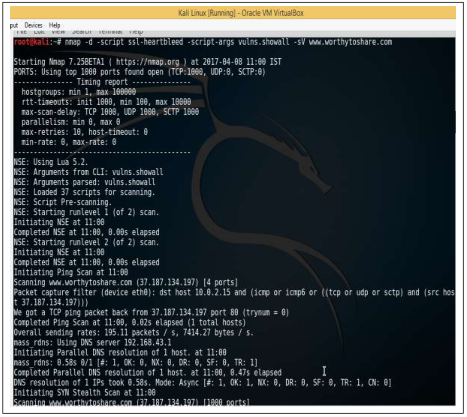
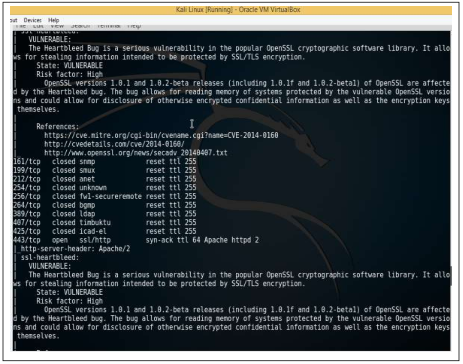
5.1 Checking Heartbleed vulnerability with nmap in Kali Linux
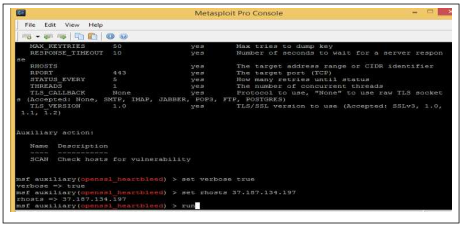
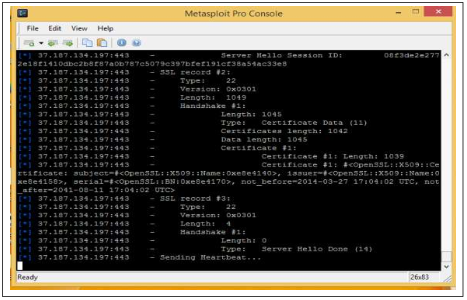
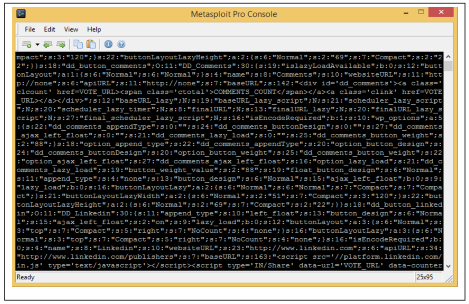
5.2 Exploiting Heartbleed Vulnerability with Metasploit
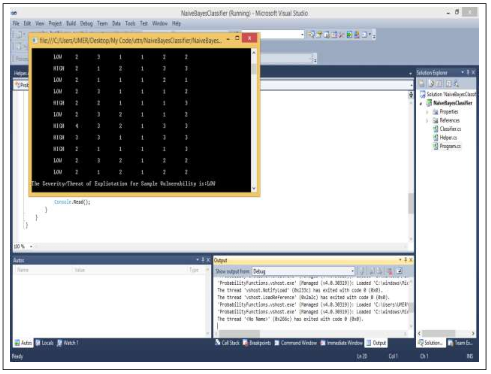
5.3 Output Of Gaussian Naive Bayes Method for Prediction of Severity of Exploitation for a Sample Vulnerability
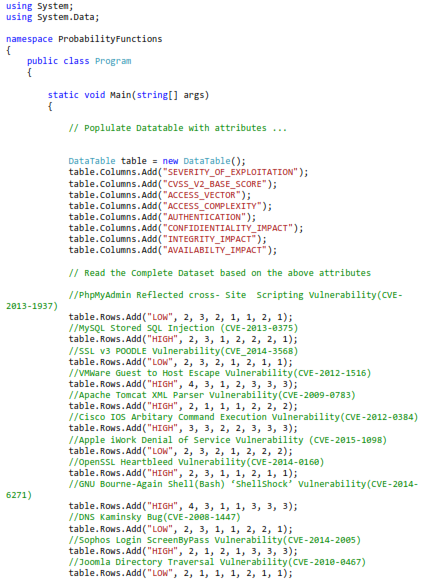
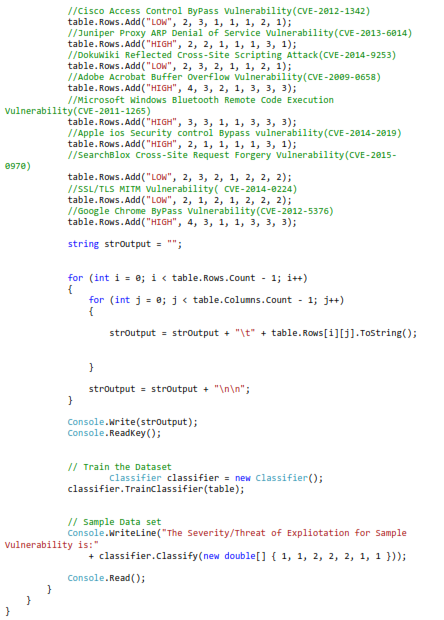
5.4 C# Code Segments for Predicting Severity/Threat Of Exploitation using Gaussian Naive Bayes Approach
5.4.1 Populating DataTable & Classifying Data Using Classify Function
5.4.2 Calculating Probabilities
namespace ProbabilityFunctions
{
public class Classifier
{
private DataSet dataSet = new DataSet();
public DataSet DataSet
{
get { return dataSet; }
set { dataSet = value; }
}
public void TrainClassifier(DataTable table)
{
dataSet.Tables.Add(table);
//table
DataTable GaussianDistribution = dataSet.Tables.Add("Gaussian");
GaussianDistribution.Columns.Add(table.Columns[0].ColumnName);
//columns
for (int i = 1; i < table.Columns.Count; i++)
{
GaussianDistribution.Columns.Add(table.Columns[i].ColumnName +
"Mean");
GaussianDistribution.Columns.Add(table.Columns[i].ColumnName +
"Variance");
}
//calculate data
var results = (from myRow in table.AsEnumerable()
group myRow by
myRow.Field<string>(table.Columns[0].ColumnName) into g
select new { Name = g.Key, Count = g.Count()
}).ToList();
for (int j = 0; j < results.Count; j++)
{
DataRow row = GaussianDistribution.Rows.Add();
row[0] = results[j].Name;
int a = 1;
for (int i = 1; i < table.Columns.Count; i++)
{
row[a] = Helper.Mean(SelectRows(table, i,
string.Format("{0} = '{1}'", table.Columns[0].ColumnName, results[j].Name)));
row[++a] = Helper.Variance(SelectRows(table, i,
string.Format("{0} = '{1}'", table.Columns[0].ColumnName, results[j].Name)));
a++;
}
}
}
public string Classify(double[] obj)
{
Dictionary<string, double> score = new Dictionary<string,
double>();
var results = (from myRow in dataSet.Tables[0].AsEnumerable()
group myRow by
myRow.Field<string>(dataSet.Tables[0].Columns[0].ColumnName) into g
select new { Name = g.Key, Count = g.Count()
}).ToList();
for (int i = 0; i < results.Count; i++)
{
List<double> subScoreList = new List<double>();
int a = 1, b = 1;
for (int k = 1; k < dataSet.Tables["Gaussian"].Columns.Count; k
= k + 2)
{
double mean = Convert.ToDouble
(dataSet.Tables["Gaussian"].Rows[i][a].ToString ());
double variance = Convert.ToDouble
(dataSet.Tables["Gaussian"].Rows[i][++a].ToString ());
double result = Convert.ToDouble (Helper.NormalDist(obj[b -
1], mean, Helper.SquareRoot(variance)));
subScoreList.Add(result);
a++; b++;
}
double finalScore = 0.0;
for (int z = 0; z < subScoreList.Count; z++)
{
if (finalScore == 0.0)
{
finalScore = subScoreList[z];
continue;
}
finalScore = finalScore * subScoreList[z];
}
score.Add(results[i].Name, finalScore * 0.5);
}
double maxOne = score.Max(c => c.Value);
var name = (from c in score
where c.Value == maxOne
select c.Key).First();
return name;
}
#region Helper Function
public IEnumerable<double> SelectRows(DataTable table, int column,
string filter)
{
List<double> _doubleList = new List<double>();
DataRow[] rows = table.Select(filter);
for (int i = 0; i < rows.Length; i++)
{
_doubleList.Add(Convert.ToDouble (rows[i][column]));
}
return _doubleList;
}
public void Clear()
{
dataSet = new DataSet();
}
#endregion
}
}
5.4.3 Helper Class
public static class Helper
{
public static double Variance(this IEnumerable<double> source)
{
double avg = source.Average();
double d = source.Aggregate(0.0, (total, next) => total +=
Math.Pow(next - avg, 2));
if (d == 0) d = 1;
return d / (source.Count() - 1);
}
public static double Mean(this IEnumerable<double> source)
{
if (source.Count() < 1)
return 0.0;
double length = source.Count();
double sum = source.Sum();
return sum / length;
}
public static double NormalDist(double x, double mean, double
standard_dev)
{
double fact = standard_dev * Math.Sqrt(2.0 * Math.PI);
double expo = (x - mean) * (x - mean) / (2.0 * standard_dev *
standard_dev);
return Math.Exp(-expo) / fact;
}
public static double NORMDIST(double x, double mean, double
standard_dev, bool cumulative)
{
const double parts = 50000.0; //large enough to make the trapzoids
small enough
double lowBound = 0.0;
if (cumulative) //do integration: trapezoidal rule used here
{
double width = (x - lowBound) / (parts - 1.0);
double integral = 0.0;
for (int i = 1; i < parts - 1; i++)
{
integral += 0.5 * width * (NormalDist(lowBound + width * i,
mean, standard_dev) +
(NormalDist(lowBound + width * (i + 1), mean,
standard_dev)));
}
return integral;
}
else //return function value
{
return NormalDist(x, mean, standard_dev);
}
}
public static double SquareRoot(double source)
{
double dblResult = Math.Sqrt(source);
return (dblResult);
}
}
}